
Serie A has started the 2026/27 season with noticeably more goals, fewer interruptions, and generally more appealing games than in recent years. With new refereeing guidelines and rule changes designed to increase effective play time, the question is whether this is simply early-season variance or the first sign of a broader shift in how the league is being played.
Key findings
- Goals have risen to 2.90 per match, up 19.5% from the 2025/26 full-season average.
- Matches are showing signs of becoming more open – less fouls, and more goals for both sides.
The analysis
The start of the 2026/27 Serie A season brought a number of changes aimed at speeding up the game, increasing effective playing time and making matches more attractive to watch. In recent seasons, the league has often been associated with low-scoring games and long periods of interrupted play. Before the season, Daniele Orsato, the new head of the National Referees Commission, encouraged referees to be more decisive and improve time management on the pitch. This approach was supported by new regulations designed to limit delays during restarts, including five-second countdowns for delayed goal kicks and throw-ins. After five matchweeks, it is still far too early to judge their full impact, but the first numbers already show some interesting changes.
The most obvious one is the number of goals. Serie A averaged 2.56 goals per game in 2024/25 before dropping to 2.43 in 2025/26. After the first 50 matches of the current season, that number stands at 2.90 goals per game – around 19.5% higher than last season and 13.3% above 2024/25. Looking only at goals, however, could easily be misleading. A few unusually clinical weeks can strongly affect such a small sample, which is why expected goals provide more context.
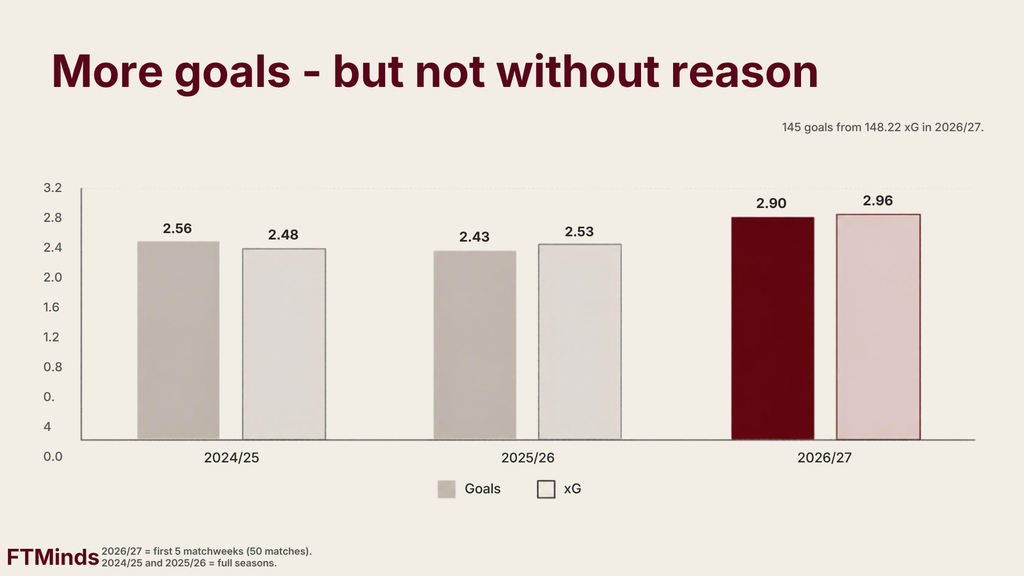
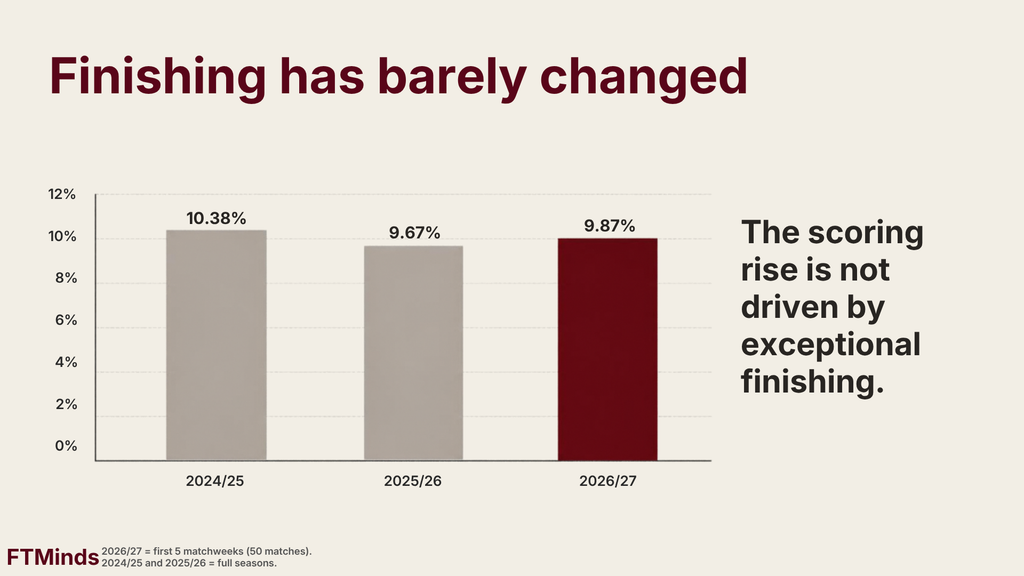
Serie A averaged 2.48 xG per game in 2024/25 and 2.53 in 2025/26, while the current season sits at 2.96 xG per match. Across the first 50 games, teams have generated 148.22 xG and scored 145 goals, meaning that the league is actually slightly underperforming its expected output. Shot conversion tells a similar story: it currently stands at 9.87%, compared with 9.67% last season and 10.38% in 2024/25. There is no extraordinary finishing streak behind the increase. The league is simply producing more and better attacking situations.
Is Serie A becoming more open?
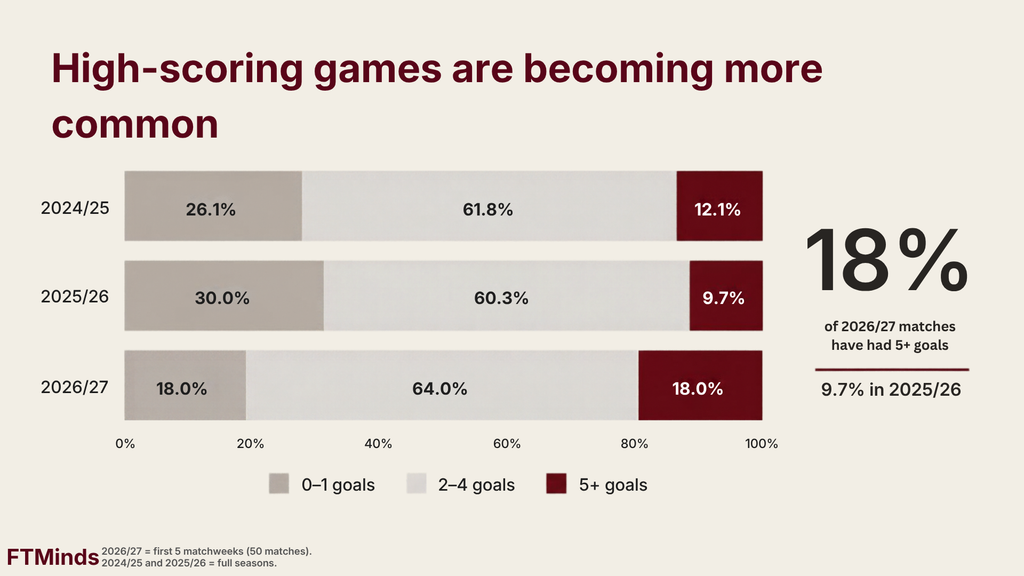
The distribution of results gives us another perspective. After 50 matches, Serie A is still waiting for its first 0-0 draw of the season. For comparison, 0-0 accounted for 7.4% of matches in 2024/25 and 9.5% in 2025/26. High-scoring games are also becoming more common: matches with at least five goals represented just over 12% of games in 2024/25 and less than 10% last season, while this year the share currently stands at 18%. The 3-2 scoreline alone has already appeared five times, meaning that one in every ten matches has ended with five goals and a one-goal difference. At the same time, this does not mean that the traditional Serie A scorelines have disappeared. A 1-0 result still represents 18% of matches and remains one of the most common outcomes. What seems to be changing is not the disappearance of low-scoring games, but the overall distribution, with more matches appearing at the high-scoring end. BTTS data supports the same picture: both teams have scored in 54% of matches, compared with 44.2% last season and 51.6% in 2024/25.
More football, fewer interruptions?
Another interesting change can be seen in the number of fouls. Serie A averaged 25.06 fouls per game in 2024/25 and 25.28 in 2025/26. This season, that figure has fallen to 22.86, almost 10% lower than last year.
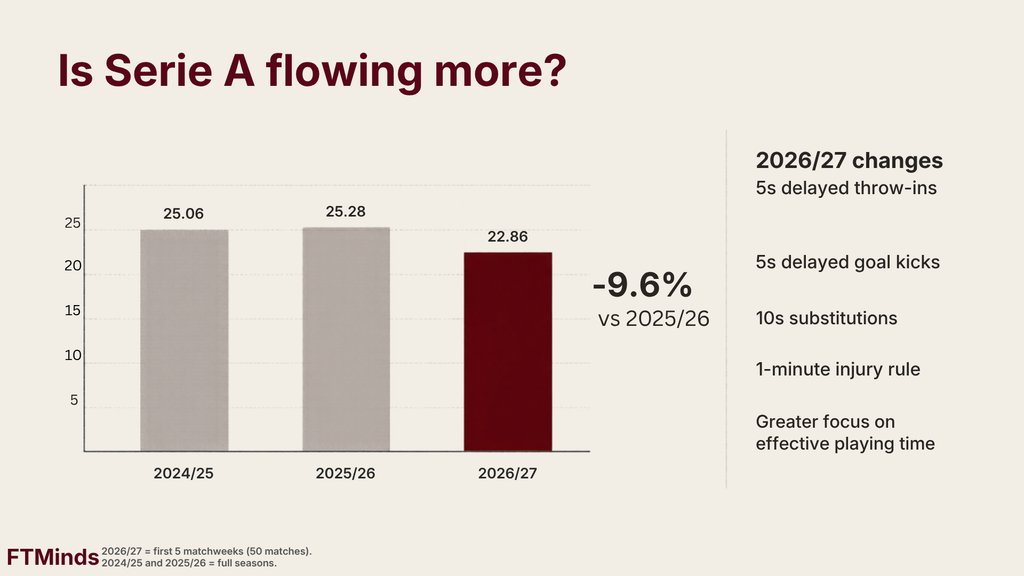
At the same time, both goals and expected goals have increased considerably. It is tempting to connect those numbers directly with the new refereeing approach and regulations designed to improve match flow: fewer fouls and faster restarts could mean fewer interruptions, more active playing time and eventually more attacking situations. After only five matchweeks, however, there is not enough evidence to establish a direct causal relationship. What we can say is that the early numbers are moving in exactly the direction those changes were meant to encourage – fewer interruptions, more attacking production and more goals.
A real shift or an early-season anomaly?
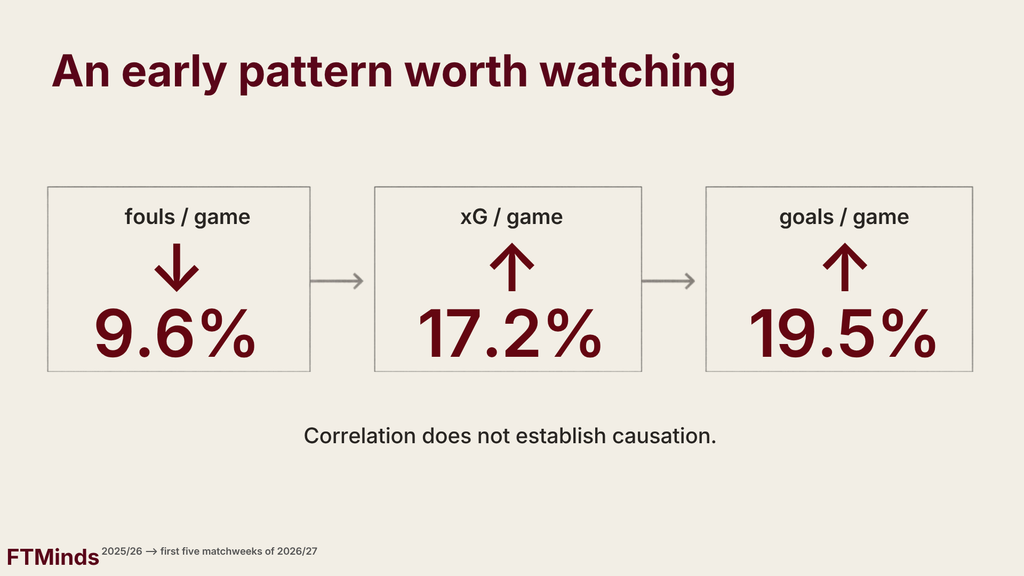
Fifty matches are obviously not enough to announce the end of the traditional low-scoring Serie A. The sample is still small, and the numbers will almost certainly move as the season progresses. Still, the early trend is difficult to ignore. Goals have increased from 2.43 to 2.90 per game, while xG has moved from 2.53 to 2.96. Shot conversion has remained almost unchanged, suggesting that the rise in scoring is being driven by chance creation rather than unusually efficient finishing. At the same time, fouls are down, 0-0 draws have disappeared for now, BTTS is up and high-scoring matches are appearing more frequently. Whether this is the beginning of a structural change in Serie A or simply an unusual start to the season will become clearer with a larger sample. For now, however, one conclusion stands out: Serie A is not only scoring more. It is creating more.
Method & limitations
Analysis compares the opening five matchweeks of the 2026/27 season with full-season data from 2024/25 and 2025/26. Current-season statistics are represented by an early snapshot of 50 matches. All metrics are presented on a per-match or percentage basis where appropriate to improve comparability. Current sample is still to small to establish whether the observed changes are structural or to attribute them them directly to refereeing or rule changes.
Sources
Data: Lega Serie A, statmuse.com
Rules: IFAB, AIA, FIGC
Period analysed: 2024/25, 2025/26 and first 5 matchweeks of 2026/27